INTRODUCTION
In the literature, Alzheimer's disease (AD) has been referred to as the main cause of dementia disorder in elderly patients, and its etiology still remains limited, inconsistent, and controversial1,2,3,4,5. On the other hand, there is an increasing interest in identifying the reason for late occurrence of AD. Many studies indicate that several kinds of potential risk factors are involved, such as family history (dementia, mental retardation, Parkinson's disease), behavior (smoking, alcohol abuse, coffee consumption, dietary habits), medical history (cancer, diabetes, hypertension, heart attack, head injury), life conditions (low level education, starvation/malnutrition) and others6,7,8.
Although history of closed head injury, with or without loss of consciousness, has been reported as a potential risk factor for AD, the findings from various case-control studies are inconclusive. Some show that this trauma type has a significant or nearly significant effect on AD risk, whereas others have found no association. Besides, the apparent association between remote head injury and dementia may be spurious2,9,10,11. In addition, trauma is the most common cause of hospital admission, especially in children, and seve re closed head injury is a leading cause of death and disability in the world12,13,14.
Thus, the purpose of this study was to determine, using a systematic review of meta-analysis studies, whether head injury is a significant risk factor for Alzheimer's disease.
METHODS
Selection of studies - There are various studies in specialized literature showing the relationship between head trauma injury, as a risk factor, and the later occurrence of AD. Using a meta-analysis statistic model, we investigated the interaction between head trauma and AD. This method of analysis involves three phases: identifying studies in specialized literature that are related to the topic; analyzing the results of the selected studies; integrating the results within a statistical model. The use of meta-analysis in these cases is very efficient, as it not only aggregates the results of selected studies, but also, individually, estimates the effect of each of them and tests the statistical significance of the total result of the studies in association.
Our investigation included 20 case-control studies which had previously been published on Medline from 1990 until 2004. The selection criteria defined as head trauma a broad range of injuries that lead the patient to seek hospitalization or medical care, with or without loss of consciousness; submission at least to a Mini-Mental State Examination (MMSE) to characterize the mental depression.
Statistical analysis - Analyses of two-by-two contingence table were performed. For each case-control study, the association between prior head trauma injury, with or without loss of consciousness, and AD was estimated in terms of odds ratio and 95% confidence intervals (CI). Mantel-Haenszel adjusted odds ratio (OR) were calculated in stratified data. The Mantel-Haenszel method gives an estimate of the OR for each study when all the studies are jointly considered. Odd ratio calculation, according to the Mantel-Haenszel method, represents the ratio between the chance of an exposed group and a non-exposed group. If the chances are the same, the OR will be 1, but if they are not, the OR calculation is a direct way, in relative terms, of showing the different chance (greater or smaller) for the exposed group15,16. This study considered exposure to head trauma injury, which meant that the OR was calculated by finding the ratio of chances of AD occurrence associated to head trauma with the chances of AD occurrence without that kind of trauma. Epi Info statistical software was used to determine p-value with significant level at 5%.
RESULTS
After individually analyzing all the selected studies and re p o rting the relationship of head trauma injury and AD. In 16 out of the 20 studies evaluated, a direct association between this kind of trauma and occurrence of AD was observed. However, among these 16 studies, there was statistical significance only in five studies. When all the 20 studies were considered jointly the results showed statistical significance. The meta-analyses ofall 20 studies showed that a history of head injury was associated with dementia due to AD with OR estimated at 3.17 (95%CI 3.12 to 3.92, and p-value <0.00000001). The results of meta-analysis for all studies are given in table 1. Figure 1 shows the individual and combined OR for all studies.
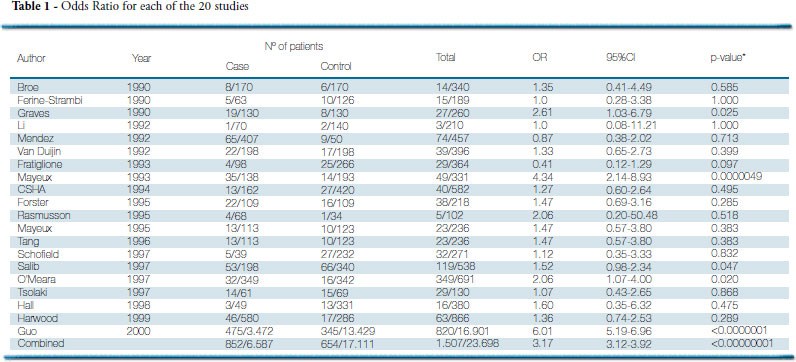
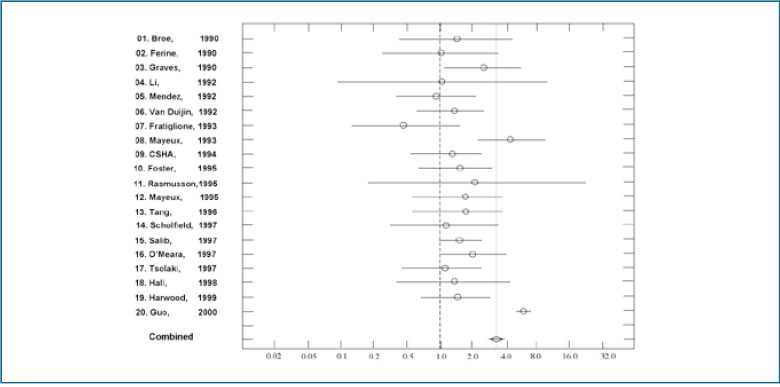
Figure 1 - odds ratio and 95% confidence intervals for each of the 20 studies, and overall estimated odds ratio. Bars indicate 95% confidence in confidence intervals. The dashed line marks an odds ratio of 1.0, or no effect.
DISCUSSION
Alzheimer disease is the most common cause of dementia in elderly patients. It is characterized as a heterogeneous disorder that may be caused by genetic or environmental risk factors or by a combination of both. In spite of much research during the last decade, the etiology of AD disease in most cases remains unknown17,18,19,20,21. Pathologically, it is associated with the presence of numerous senile plaques and neurofibrillary tangles throughout the cerebral cortex. New studies have revealed that the altered metabolism of the _-amyloid precursor protein, such as aberrant processing or excessive production, is a main event involved in the pathogenesis and maintenance of the disease process22,23,24.
On the other hand, several preexistent conditions have been cited as risk factors for late-onset AD. Based on epidemiological and neuropathological evidence, head injury has been considered a risk factor However, case-control and cohort studies suggest that there has been an over-representation of head injury as the best-established environmental catalyst to trigger or promote an event in the pathogenesis of AD25,26,27,28. Consequently, there are several possible mechanisms by which traumatic brain injury might increase the risk for AD. Head injury might cause cerebral damage and lower the reserve against the cognitive consequences of subsequent, entirely unrelated cerebral pathology including AD. As a result neuropsychological abnormalities may persist for weeks or even months after injury6,29.
Even though neurotoxicity of amyloid has not been positively confirmed in experimental animals, recent studies indicate that the relationship between head injury and AD is consistent with a hypothesis that cerebral amyloid deposition may lead to formation of neuritic plaques and neuronal destruction1,2. With severe traumatic brain injury, at least, upregulation of amyloid precursor protein processing may occur, caused by _-amyloid protein accumulation in neurons, presumably as an acute-phase response to injury. This response may result in the destruction of the cell membrane and cytoskeleton with neuronal degeneration and death17,18. Thus, deposited amyloid following severe head injury is thought to be the main environmental risk factor involved as the precursor that contributes to AD onset. Nevertheless, according to Mayeux et al22, head injury has been implicated in the causal pathway of other degenerative diseases such as Parkinson's disease and amyotrophic lateral sclerosis. This association is questionable or even inconsistent
Since epidemiological evidence relates traumatic brain injury as an increased risk for subsequent development of molecular alterations involved in neuropathology of earliest stage AD, we expected to observe in the study a stronger association between head injury and this mental affection. In fact, this kind of trauma has significant importance since the most severe traumatic brain injury results in death or long-term disability. I United States approximately 2 million individuals sustain some head injury degree each year1,6,10.
In addition, in a retrospective historical cohort design, Plassman et al10 analyzed 548 World War II Navy and Marine male veterans hospitalized during their military service with a diagnosis of either nonpenetrating head injury or another unrelated condition. The authors concluded that moderate and severe head injuries in young men may be associated with increased risk of AD and other dementias late in life. Foster et al.30 also reported that head injury is associated with younger age of onset of AD. On the other hand, a retrospective cohort study performed by Williams et al.31 found no association between AD and head-injured people. These results were corroborated by Li et al.32 and Fratiglione et al.11. According Guo et al.9, there is indirect evidence supporting the view that head injury could be a risk factor for AD, such as repeated head injury experienced by boxers, for example.
In this study we investigated, in 20 case-control studies previously published, the risk for subsequent incident of AD associated with a history of head injury. Table 1 demonstrates that most of the studies analyzed presented positive results and a tendency to accept the association between head injury and increased risk of AD. In the same way, when all the studies were evaluated as a whole, the result demonstrated that the total odds ratio was highly favorable in relation to AD occurrence following prior head injury (OR=3.17; p-valor<0.0000001).
Although, the partial results obtained from previous studies may be inconclusive or even contrary, when taken individually, meta-analysis is an appropriate method to be used, even though those case-control studies are susceptible to recall bias which may explain the different results observed between head injury and this disease. Therefore, the risk factors should be further studied, using metaanalysis with a more consistent and objective approach, so that more information are obtained regarding the true association between traumatic brain injury and Alzheimer's disease.
In summary, our results indicate that trauma head injury may be related with AD, and are consistent with the results of several previous case-control studies. This suggests that a history of head injury, with or without loss consciousness, is positively associated with AD. Patients with a history of head trauma injury has a three-fold increased risk of developing Alzheimer's disease when compared to patients without this kind of trauma.
REFERENCES
1. 1. Mayeux R, Ottman R, Tang MX, et al. Genetic susceptibility and head injury as risk factors for Alzheimer's disease among community-dwelling elderly persons and their first-degree relatives. Ann Neurol 1993;33(5):494-501.
2. McKenzie JE, Gentleman SM, Roberts GW, et al. Increased numbers of bAPP-immunoreactive neurons in the entorhinal cortex after head injury. Neuroreport 1994;6(1):161-4.
3. Hall K, Gureje O, Gao S, et al. Risk factors and Alzheimer's disease: a comparative study of two communities. Aust N Z J Psychiatry 1998;32(5):698-706.
4. Harwood DG, Barker WW, Loewenstein DA, et al. A cross-ethnic analysis of risk factors for AD in white Hispanics and white non-Hispanics. Neurology 1999;52(3):551-6.
5. Fleminger S, Oliver DL, Lovestone et al. Head injury as a risk factor for Alzheimer's disease: the evidence 10 years on; a partial replication. J Neurol Neurosurg Psychiatry 2003;74(7):857-62.
6. Schofield PW, Tang M, Marder K, et al. Alzheimer's disease after remote head injury: an incidence study. J Neurol Neurosurg Psychiatry 1997;62(2):119-24.
7. Mendez MF, Underwood KL, Zander BA, et al. Risk factors of Alzheimer disease: a clinicopathologic study. Neurology 1992;42(4):770-5.
8. Bidzan L, Ussrowska D. Risk factors for dementia of Alzheimer's type. Psychiatria Polska 1995;29(3,suppl):147-52.
9. Guo Z, Cupples LA, Kurz A, et al. Head injury and the risk of AD in the MIRAGE study. Neurology 2000;54(6):1316-23.
10. Plassman BL, Havlik RJ, Steffens DC, et al. Documented head injury in early adulthood and risk of Alzheimer's disease and other dementias. Neurology 2000;55(8):1158-66.
11. Fratiglioni L, Ahlbom A, Viitanen M, et al. Risk factors for late-onset Alzheimer disease: a population-based, case-control study. Ann Neurol 1993;33(3):258-66.
12. Fagerli J, Chendrasekhar A. the effect of severe closed head injury on the incidence of nosocomial infections. W V Med J 1996;92(5):265-7.
13. Lam WH, MacKersie A. Paediatric head injury: incidence, aetiology and management. Paediatr Anaesth 1999;9(5):377-85.
14. Lee KS. Estimation of the incidence of head injury in Korea: an approximation based on national traffic accident statistics. J Korean Med Sci 2001;16(3):342-6.
15. Hosmer DW, Lemeshow S. Applied logistic regression. New York: John Wiley & Sons Inc., 1989.
16. Jekel JF, Elmore JG, katz DL. Epidemiologia, Bioestatística e Medicina Preventiva. Porto Alegre, Artes Médicas Sul, 1999. 328 p.
17. Graham DI, Gentleman SM, Nicoli JAR, et al. Is there a genetic basis for the deposition of _-amyloid after fatal head injury? Cell Mol Neurobiol 1999;19(1):19-30.
18. O'Meara ES, Kukull WA, Sheppard L, et al. Head injury and risk of Alzheimer disease by apolipoprotein E genotype. Am J Epidemiol 1997;146(5):373-84.
19. Henderson AS, Jorm AF, Korten AE, et al. Environmental risk factors for Alzheimer's disease: their relationship to age of onset and familial or sporadic types. Psychol Med 1992;22(2):429-36.
20. Tang MX, Maestre G, Tsai WY, et al. Effect of age, ethnicity, and Alzheimer's disease. Ann NY Acad Sci 1996;80:6-15.
21. Broe GA, Henderson AS, Creasey H, et al. A case-control study of Alzheimer's disease in Australia. Neurology 1990;40:1968-707.
22. Mayeux R, Ottman R, Maestre G, et al. Synergistic effects of traumatic head injury and apolipoprotein-epsilon 4 in patients with Alzheimer's disease. Ne rology 1995;45(3):555-7.
23. Graham DI, Gentleman SM, Lynch A, et al. Distribution of _-amyloid protein in the brain following severe head injury. Neuropathol Appl Neurobiol 1995;21(1):27-34.
24. Nicoll JAR, Roberts GW, Graham DI. Amyloid _-protein, APOE genotype and head injury. Ann N Y Acad Sci 1996;777:271-5.
25. Salib E, Hillier V. Head injury and the risk of Alzheimer disease: a case control study. Int J Geriatr Psychiatry 1997:12(3):363-8.
26. Graves AB, White E, Koepsell TD, et al. The association b e t ween head trauma and Alzheimer's disease. Am J Epidemiol 1990;131(3):491-501.
27. Van Duijn CM, Tanja TA Haaxma R, et al. Head trauma and the risk of Alzheimer's disease. Am J Epidemiol 1992;135(7):775-82.
28. Ferini - Strambi L, Smirne S, Garancini P, et al. Clinical and case control study. Neuroepidemiology 1990;9:39-49.
29. Rasmusson DX, Brandt J, Martin DB, et al. Head injury as a risk factor in Alzheimer's disease. Brain Injury 1995;9:213-19.
30. Forster DP, Newens AJ, Kay DWK, et al. Risk factors in clinically diagnosed presenile dementia of the Alzheimer type: a case control study in northern England. J Epidemiol Community Health 1995;49:253-8
31. Williams DB, Annegers JF, Kokmen E, et al. Brain injury and neurologic sequelae: a cohort study of dementia, Parkinsonism, and amyotrophic lateral sclerosis. Neurology 1991;41(10):1554-7.
32. Li G, Shen YC, Li YT, et al. A case-control study of Alzheimer disease in China. Neurology 1992;42:1481-8.